Water in an Oxnard house, or a hillside on the move above one in Santa Paula: our nearest crew goes out at any hour, anywhere in Ventura County, and stays until the place is dry and put back together.

SOS Restoration of Ventura County handles the six kinds of damage that make a house unlivable, from the wet carpet on the first day to the last coat of paint. Oxnard, the other nine incorporated cities, and the ranch country between them. Call (805) 427-9039 and our dispatcher will name the valve you are looking for.

Two kinds of night keep this phone busy. One begins inside the house, with a supply line letting go behind a bathroom wall while everybody sleeps, so the first anyone knows of it is a wet sock. The other begins on a hillside. There is a burn scar above Simi Valley, 2,183 acres of it, facing its first wet season, and on ground that raw a third of an inch of rain in a quarter of an hour is a coin flip on whether rock and mud start moving toward whatever sits below. Fifteen minutes. Not a storm.

Both kinds end the same way, with somebody standing in the dark in soaked shoes, deciding who to wake up.

That decision is the whole business. Water damage is most of what we do, and mold is what the slow, quiet version of it turns into. We also take fire and smoke, storm damage for the nights the roof or the slope gives way, and sewage, which nobody wants to describe out loud and which gets worse every hour it waits. That is five. The sixth is the one most companies leave out of the conversation: once the house is dry and half of it has gone to the curb, we build it back. Studs and insulation where they had to come out, wall board hung and textured to match, paint, casing, hung doors, cabinetry reset, countertop, floor.

Water is coming in right now. What do I do first?

1

Kill the water, kill the power in the wet rooms, photograph everything, then call.

2

That is the next ten minutes. Three objects decide them: a valve, a breaker, and the camera in your hand.

3

  1. Kill the water. For one fixture it is the little handle on the wall behind it. For the whole house it is usually at the meter box near the curb or beside the water heater. Cannot find it in ninety seconds? Leave it and go to step two.
  2. Breaker off for any room the water has reached, if an outlet, a cord or a wall heater is anywhere near it. Then put shoes on before you walk back through.
  3. Shoot photos before you touch a thing. One wide frame per room, then close on the ceiling stain, the swollen baseboard, the box on the closet floor. Give it a day and the whole scene looks half as bad, and nobody believes the tidy version.
  4. Rescue the light stuff. Paper, shoes, chargers, the rug lying across hardwood, because rug dye travels into wood and does not come back out.
  5. Now call. Tell us the city, the room, and roughly how long it has been running.

4

If what came in is mud rather than tap water, add one rule: stay out of it while it is still raining. A slope that let go once will happily do it again, and there is nothing in a garage worth standing under a hill for.

5

The reason for the hurry is a clock, and it is shorter than people expect. The EPA puts the window at twenty-four to forty-eight hours. Material pulled dry inside it usually never grows anything at all. Let it run past that and the job quietly changes: now it is drying plus everything that started living in the wet, and that half costs more than the water ever did.

Water damage

Water damage restoration across Ventura County, open 24 hours: extraction, drying, and dated readings until the house holds dry. Call (805) 427-9039.

Mold

Mold removal and inspection in Ventura County, CA. The order the work happens in, what gets torn out, and how dry is dry. Call (805) 427-9039, any hour.

Fire & smoke

Fire and smoke damage restoration across Ventura County: soot, odor, board-up, drying, and the rebuild after. Call (805) 427-9039, open 24 hours.

Storm damage

Storm and debris flow damage in Ventura County: water and mud out, the structure dried on meter readings, rooms rebuilt. Open 24 hours, (805) 427-9039.

Sewage cleanup

Sewage backup cleanup in Ventura County: what leaves the house, how we measure the wet line, and who puts the room back. Call (805) 427-9039, day or night.

Reconstruction

We rebuild what the loss took out across Ventura County: framing to final paint, one fixed written price, permits filed. CSLB #1131134. Call (805) 427-9039.

Where we go

Ten incorporated cities and the unincorporated ground between them. Oxnard is where the pin sits, and nobody in the county gets told they are outside the zone.

Who shows up, and how far do you come?

Our own crews, in our own trucks, and the far corner of the county is not too far.

The service rule here is a county line, not a circle drawn around a warehouse. Ventura County has ten incorporated cities and we work all ten. Oxnard is where the pin sits, and from there it is Ventura and Port Hueneme along the coast, Camarillo, Moorpark and Simi Valley inland, Santa Paula and Fillmore up the river, Ojai in its own valley, Thousand Oaks at the southern end, and the ranch roads and packing houses in between. Oxnard to Simi Valley is about forty miles, roughly the whole width of the place. Nobody here gets told they are outside the zone. Who we are is worth two minutes before you let anybody in.

We already know which way the water runs here.

The Santa Clara River collects close to sixteen hundred square miles of back country over eighty-four miles of channel before it reaches the ocean between Oxnard and Ventura, which is why one wet week upstream turns into a problem in a farm town two days later. Calleguas Creek does the same trick on the other side of the county, thirty-seven miles of it, gathering Arroyo Simi and Arroyo Las Posas as it passes Simi Valley, Moorpark and Camarillo. The burn scars keep their own calendar on top of that: the USGS has run emergency debris-flow assessments for eight fires touching this county in a little over ten years, which makes it routine here rather than exceptional.

Check the license number on any restoration website before you let that company through your door.

California requires it on every piece of advertising there is, print, lettering on a vehicle, any electronic transmission, and plenty of sites in this county still carry none. Ours are CSLB #1131134 and IICRC #70194273. Write them down, look them up, then decide.

What does it cost to have somebody look at it?

Nothing. The visit and the written scope are free, and they put you under no obligation.

Somebody drives out, walks a meter over the walls and the floor, and separates the material that is actually holding water from the material that only looks alarming. Take the readings, thank us at the door, and hand them to a different company if that is your read on it. Nothing from that hour turns up on a later bill.

Mitigation runs on the clock. Water damage work starts at $61 an hour, and the emergency, fire, smoke, mold and sewage work starts at $90 an hour, because that is the end of the card where the suits, the containment and the disposal live. What actually swings the figure is on the cost page: how many rooms are wet, how long it ran, and whether it was clean supply water or something that came back up a drain.

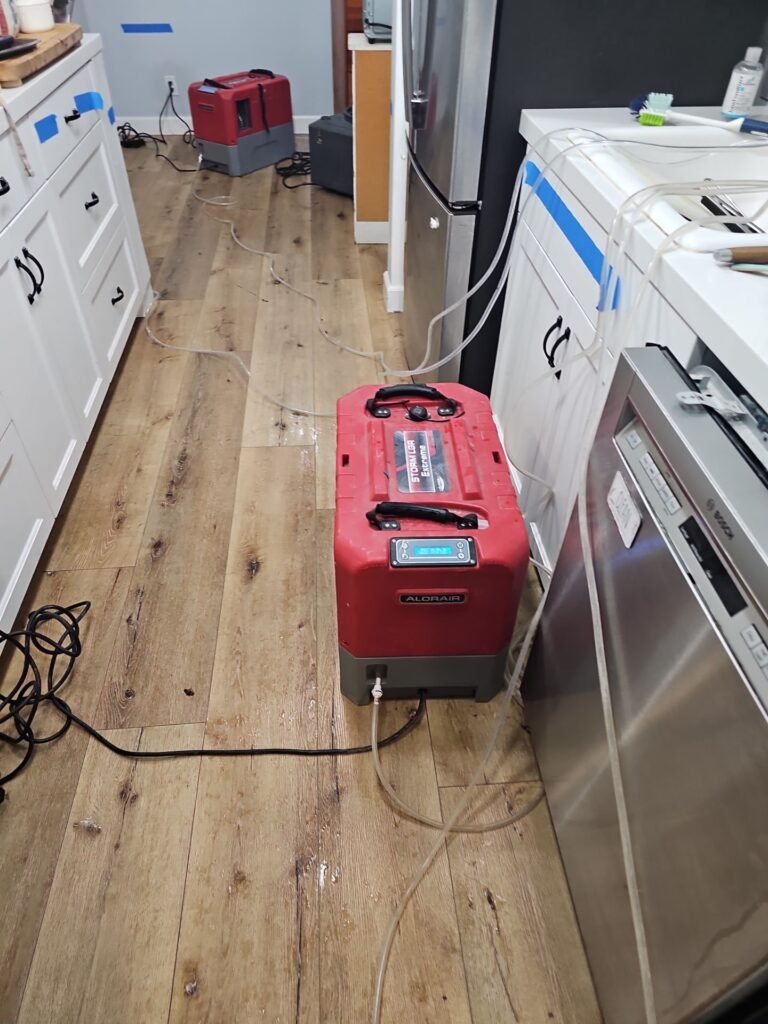
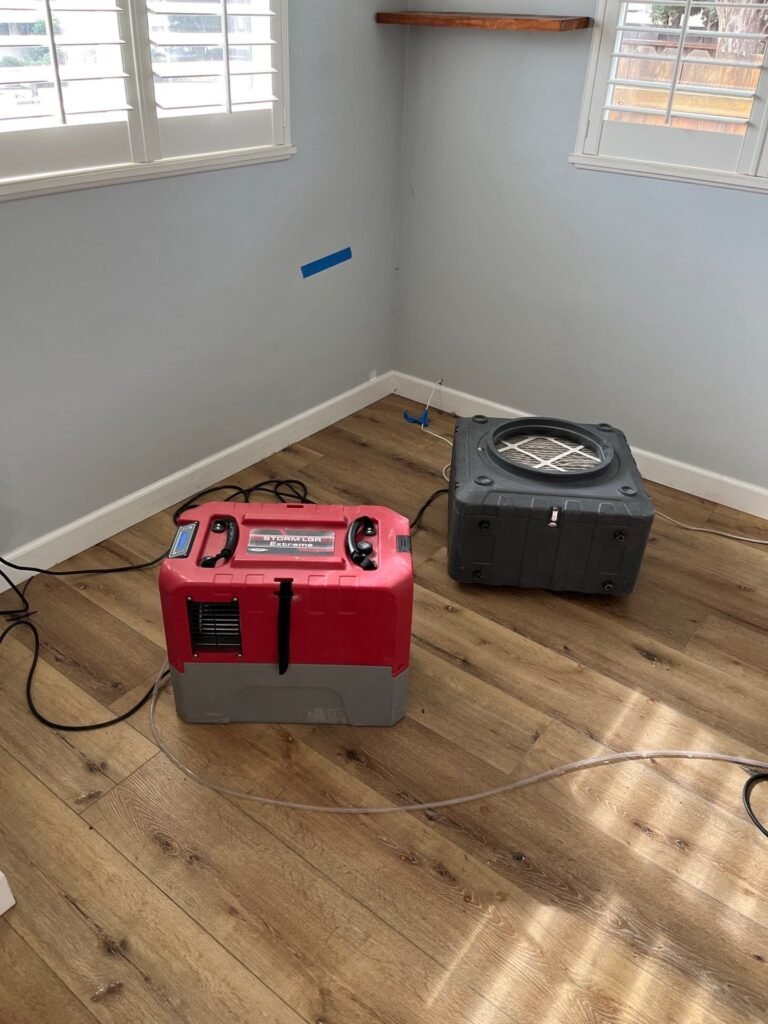
What the hour buys is people and work. Pulling the water, cutting out what is beyond saving, setting equipment and moving it as the wet edge shrinks, and coming back for readings until the numbers match the dry side of your own house.

What the hour does not buy is the rebuild. That half arrives as a single written figure, settled before anyone unloads a saw, because state law will not allow a home improvement job to be metered: the paperwork has to name one total, in dollars, up front. A rebuild sold by the hour is not a bargain here. It is not even a valid contract.

Baseboards removed and the wall cavity opened to dry a Ventura County living room

You dry it. Do you also put the house back together?

Yes. Same company, same crews, one contract with the whole total written on the front of it.

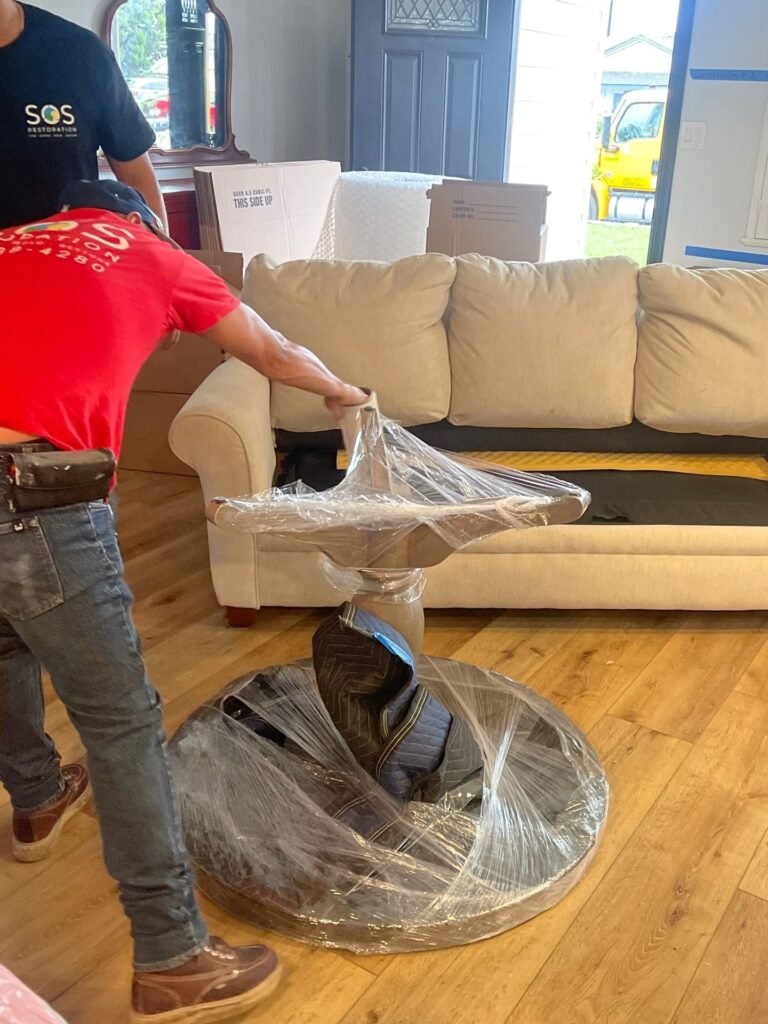
Drying a house and leaving the owner holding a demolition site is the standard complaint about this trade, so we carry the job through the second half. Walls closed, texture matched so the patch does not announce itself across the ceiling, trim run, doors hung and shimmed, cabinets reset and counters templated, floor laid, until the room is a room again.

The second half is where local knowledge stops being decoration. More than half the housing in this county predates 1980, and the median Oxnard house dates to 1977, which is why a sample goes to a lab before a saw goes into a wall. Asbestos here answers to the county’s own air district, the Ventura County Air Pollution Control District, under its Rule 62.7: a filing for any renovation that disturbs a hundred square feet of the material, and a filing for any demolition where there is asbestos at all. What gets tested first explains what that adds to the front of a rebuild.

Flood zones change the rebuild too, before the first stud goes in. Oxnard is one of only three communities in the county enrolled in FEMA’s Community Rating System, at Class 7, which is worth fifteen percent off a flood insurance premium inside the special hazard area and five percent outside it. The city buys that discount by enforcing floodplain rules tighter than the federal minimum, and those tighter rules land on your permit. A good share of the exposure here is ocean rather than river: roughly 1,503 acres of the city sit in the wave velocity zone, where the foundation method is dictated and solid walls below the flood elevation are not allowed. The map that governs any of it is the 2021 one, whatever an older printout in a file drawer says.

One more thing worth knowing before you sign anything. In California an insurance company cannot steer you to a repair contractor unless it has told you in writing, first, that picking your own is your call. Almost nobody in this market puts that sentence on a website, which is exactly why it is on this one.

¿Atienden en español?

Sí, y sin traductor de por medio: la cuadrilla que llega a su casa habla español.

Llame al (805) 427-9039 y cuente lo que pasó como lo contaría en su cocina. Lo que usted vaya a firmar se lo leemos en español antes, renglón por renglón, incluida la parte del precio. Si es inquilino y no dueño, la llamada vale igual.

That last line is not a courtesy, it is arithmetic: close to half of the households in Oxnard rent rather than own, and a renter’s emergency is a real emergency. Same meters, same photographs, same written file, handed to you so you can pass it to whoever holds the policy. Ask for a copy on the contact page and it comes to your email, not just theirs.

What happens after you leave?

By that point the readings have held flat for three days, the paint matches, and you are walking your own house with a punch list in your hand instead of a bucket.

Something else is in your hand by then: a folder. Worth opening before the last truck pulls off your street, because a few of those pages are addressed to desks other than ours.

The moisture log and the photographs are ours end to end.

Every reading, room by room, dated, with the frames shot in the first hour and an invoice tying the hours to the work. That stack is the strongest thing you carry into a claim, and it is also where our authority stops. The amount your carrier pays gets decided at the carrier’s desk, out of that file and the policy language, so anyone who promises you today what the check will say is reading tea leaves.

Any lab result in there carries the lab’s letterhead, not ours.

We collect a sample and ship it; whoever runs it owns the number that comes back. That gap is deliberate. An outfit that scores its own paper is not a witness.

The structural sheets and the permit card belong to other desks too.

A cracked beam or a slab that has shifted comes back as a sealed drawing from an engineer, and that drawing runs the framing crew, ours included, line for line. The card on the wall gets initialed by a city inspector, and those initials close the job, not our word that it looks square. One page you will not find in the folder is the kitchen island you have been wanting for years. The file covers what the water took; a wish list is its own conversation and its own signed contract.

What is left when the last truck goes is quieter than people expect. A room that smells of fresh paint, a folder on the counter that nobody has to open, and a hallway you can walk down without thinking about the night it happened.

Can't call right now? Send it and we call you.

Your phone number is the only thing we really need. Everything else just helps us send the right crew with the right equipment.

If a wall is wet in Oxnard or a hillside just moved above a house in Santa Paula, dial (805) 427-9039, day or night. Name the city you are standing in and our nearest crew starts loading.